1. Why Refrigerant Leaks Happen in South Florida
Refrigerant leaks are one of the most common AC problems in Boynton Beach and throughout Palm Beach County — and the reason comes down to South Florida's unique climate. Unlike most of the country, where air conditioners run seasonally for 4–6 months per year, Boynton Beach AC systems operate nearly year-round, often 10–12 months annually. This continuous operation creates significantly more wear on all mechanical components, including the refrigerant system.
Formicary Corrosion: South Florida's Most Common Leak Cause
The most prevalent cause of refrigerant leaks in Boynton Beach homes is formicary corrosion — a chemical process in which formic acid attacks copper refrigerant tubing. Formic acid is present in many common household products including cleaning solutions, adhesives, and even some building materials. When formic acid combines with moisture and oxygen in the presence of copper, it creates tiny pits and channels through the copper tubing — eventually creating pinhole leaks that slowly release refrigerant.
South Florida's extreme humidity accelerates this process dramatically. Boynton Beach's average relative humidity exceeds 75% for much of the year, providing the moisture component that drives formicary corrosion. The result is that evaporator coils in Boynton Beach homes often develop formicary corrosion leaks within 5–10 years of installation — far faster than in drier climates.
Salt-Air Corrosion from Coastal Exposure
Boynton Beach's proximity to the Atlantic Ocean and the Intracoastal Waterway means that salt-laden air is a constant presence. Salt air accelerates corrosion on all metal components, including copper refrigerant lines, aluminum fins on the evaporator and condenser coils, and steel connections. Homes within a mile of the ocean or Intracoastal experience significantly higher rates of refrigerant leak-related corrosion than inland properties.
Mechanical Wear on Fittings and Connections
Refrigerant leaks also occur at mechanical connection points — Schrader valves, flare fittings, brazed joints, and service ports. These connections experience thermal expansion and contraction with every heating and cooling cycle. In Boynton Beach's climate, where AC systems cycle frequently and year-round, these connection points experience significantly more thermal stress than in cooler climates, leading to gradual loosening and eventual leaks.
Physical Damage and Improper Installation
Refrigerant leaks can also result from physical damage to refrigerant lines — from lawn equipment, pest activity, construction work, or even improper installation by a previous contractor. Improperly brazed joints, over-tightened fittings, and kinked lines are installation errors that may not manifest as leaks immediately but develop into significant problems over time.
2. Signs You Have a Refrigerant Leak in Your Boynton Beach Home
Refrigerant leaks don't always announce themselves dramatically. In many cases, the symptoms develop gradually over weeks or months as refrigerant slowly escapes the system. Recognizing these signs early can save Boynton Beach homeowners thousands of dollars in compressor repairs.
Warm or Insufficiently Cool Air
The most noticeable symptom of a refrigerant leak is warm or insufficiently cool air coming from your vents. In Boynton Beach's summer heat, this becomes apparent quickly — your AC is running, but the house isn't getting cool. This happens because refrigerant is the working fluid that actually absorbs heat from your indoor air. Without sufficient refrigerant, the heat transfer process is compromised and your system cannot reach the thermostat's target temperature.
Ice Formation on the Evaporator Coil or Lines
Paradoxically, a refrigerant leak can cause ice to form on your AC system. When refrigerant levels are low, the evaporator coil gets too cold — below the freezing point of the moisture in the air passing over it. This moisture freezes on the coil, forming ice that eventually blocks airflow entirely. If you notice ice on the copper lines running from your indoor unit or on the unit itself, shut the system off and call a technician immediately.
Hissing or Bubbling Sounds
Refrigerant leaks often produce audible sounds — a faint hissing noise (gaseous refrigerant escaping) or a bubbling sound (liquid refrigerant leaking from a pressurized line). These sounds may be subtle and intermittent. If you hear unusual sounds near your indoor air handler or outdoor condenser unit, it's worth having a professional investigate.
Elevated Energy Bills
When refrigerant levels are low, your AC system runs longer cycles trying to reach the thermostat's set temperature. This extended runtime translates directly into higher electricity consumption. Boynton Beach homeowners often notice a 20–40% increase in their FPL bill before connecting it to a refrigerant leak. If your energy bills have risen unexpectedly without a change in usage habits, a refrigerant leak is one of the first things to investigate.
Continuous System Operation
A properly functioning AC system cycles on and off as it reaches and maintains the thermostat's target temperature. An AC system with a refrigerant leak may run continuously — or for very long cycles — because it can never quite reach the target temperature. In Boynton Beach's climate, this continuous operation further stresses the compressor and accelerates wear.
Increased Indoor Humidity
One of the critical functions of an air conditioner is dehumidification — removing moisture from indoor air as part of the cooling process. A refrigerant leak reduces the system's dehumidification capacity. If your Boynton Beach home feels sticky and humid even with the AC running, a refrigerant leak may be compromising your system's ability to remove moisture from the air.
3. Health & Safety Risks of AC Refrigerant Leaks
Beyond the impact on comfort and energy costs, refrigerant leaks carry genuine health and safety risks that Boynton Beach homeowners should understand.
Refrigerant Exposure Risks
Modern refrigerants like R-410A are generally considered low-toxicity, but exposure to high concentrations can cause dizziness, headaches, nausea, and in extreme cases, asphyxiation. Refrigerant is heavier than air and can accumulate in low-lying areas. If you suspect a significant refrigerant leak — particularly if you smell a sweet, chemical odor — ventilate the area and call a professional.
Compressor Failure Risk
The most significant safety risk from a refrigerant leak is not to human health but to your AC system itself. Running an AC with low refrigerant causes the compressor — the most expensive component in the system — to work harder and run hotter. This can lead to compressor overheating and failure, which in rare cases can create a fire risk. More commonly, it results in compressor burnout and the need for a complete compressor replacement or system replacement.
Environmental Compliance
Refrigerants are regulated under the Clean Air Act due to their environmental impact. Knowingly venting refrigerant is illegal and subject to significant fines. All refrigerant handling — including leak repair and system recharging — must be performed by EPA 608 certified technicians using proper recovery equipment. Mr. Air AC & Electrical's technicians are fully certified and compliant with all EPA regulations.
4. Professional Refrigerant Leak Detection Methods
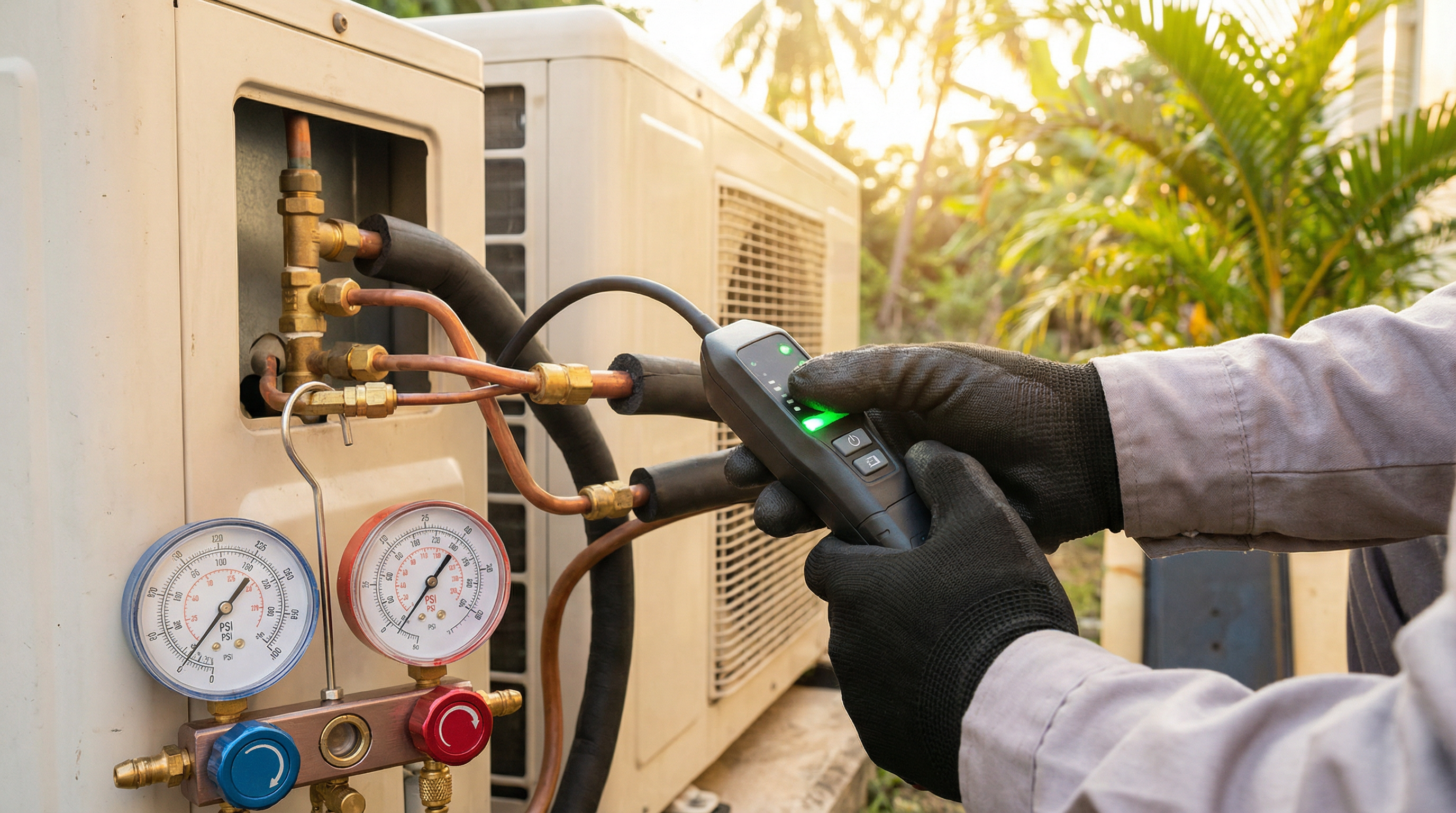
Professional refrigerant leak detection goes far beyond simply checking the system's pressure. Mr. Air AC & Electrical uses multiple detection methods to ensure leaks are found accurately and completely.
Electronic Leak Detectors
Electronic refrigerant leak detectors are handheld devices that sense the presence of refrigerant gas in the air. Our technicians systematically probe all components — evaporator coil, condenser coil, refrigerant lines, fittings, and service ports — with the electronic detector to identify leak locations. Modern electronic detectors are sensitive enough to detect leaks as small as 0.1 oz per year.
UV Dye Testing
UV dye testing involves injecting a fluorescent dye into the refrigerant system. As refrigerant escapes through a leak, it carries the dye with it. When a UV light is shone on the system, the dye glows brightly at the leak location, making it easy to identify precisely where the leak is occurring. UV dye is particularly useful for finding slow leaks that electronic detectors may miss.
Nitrogen Pressure Testing
For systems that have been fully evacuated of refrigerant, nitrogen pressure testing provides a definitive leak check. The system is pressurized with dry nitrogen — an inert, non-toxic gas — and monitored for pressure drop over time. A pressure drop indicates a leak. Nitrogen pressure testing is the most thorough method and is used when other methods have not definitively located a leak.
Visual Inspection
An experienced technician can often identify leak locations through careful visual inspection. Oil stains on refrigerant lines and components are a telltale sign — refrigerant carries compressor oil with it as it escapes, leaving visible residue at the leak point. Corrosion patterns on copper components can also indicate likely leak locations.
5. The AC Refrigerant Leak Repair Process
Understanding what happens during a professional refrigerant leak repair helps Boynton Beach homeowners know what to expect and evaluate whether a contractor is doing the job correctly.
Step 1: System Diagnosis and Leak Detection
The repair process begins with a thorough system diagnosis. The technician checks system pressures, measures temperature differentials, and uses detection equipment to locate the leak. This step is critical — a repair is only as good as the accuracy of the leak location.
Step 2: Refrigerant Recovery
Before any repair work can begin, the remaining refrigerant must be recovered from the system using EPA-approved recovery equipment. This is a legal requirement — venting refrigerant to the atmosphere is prohibited under the Clean Air Act.
Step 3: Leak Repair
The repair method depends on the type and location of the leak. Minor leaks at fittings or valves may be repaired by tightening, replacing the valve core, or re-flaring the fitting. Leaks in copper lines are typically repaired by brazing (soldering). Evaporator coil leaks may require coil replacement if the corrosion is extensive.
Step 4: Pressure Testing
After the repair is completed, the system is pressure-tested with nitrogen to verify the repair is holding. This step is essential — it confirms the leak has been fully repaired before refrigerant is added back to the system.
Step 5: System Evacuation
The system is then evacuated using a vacuum pump to remove all air and moisture from the refrigerant circuit. Moisture in a refrigerant system can cause acid formation and compressor damage, so thorough evacuation is critical.
Step 6: Refrigerant Recharge
Finally, the correct type and quantity of refrigerant is charged into the system per the manufacturer's specifications. The technician verifies system performance — checking pressures, temperatures, and airflow — to confirm the system is operating correctly.
6. Refrigerant Leak Repair Cost Guide for Boynton Beach, FL
Understanding the typical cost of refrigerant leak repair helps Boynton Beach homeowners make informed decisions and recognize fair pricing.
| Repair Type | Typical Cost Range | Notes |
|---|---|---|
| Leak detection service | $75–$150 | Diagnostic fee; often waived with repair |
| Schrader valve replacement | $100–$200 | Common, quick repair |
| Flare fitting repair | $150–$350 | Includes labor and materials |
| Refrigerant line repair (braze) | $200–$500 | Depends on accessibility |
| Refrigerant recharge (R-410A) | $150–$400 | Depends on system size |
| Evaporator coil replacement | $600–$1,500 | Most expensive common repair |
| Full system replacement | $3,500–$8,000+ | If repair is not cost-effective |
Mr. Air AC & Electrical provides upfront, written estimates before any work begins. We offer financing options for larger repairs and never add hidden fees. Call (561) 677-9897 for a free estimate.
7. DIY vs. Professional Refrigerant Leak Repair
Some Boynton Beach homeowners wonder whether they can handle refrigerant leak detection or repair themselves. The short answer is: no — and attempting to do so is both illegal and dangerous.
Why DIY Refrigerant Handling Is Illegal
Under Section 608 of the Clean Air Act, only EPA 608 certified technicians are legally permitted to purchase, handle, and recover refrigerants. Purchasing refrigerant without certification is illegal, and venting refrigerant to the atmosphere carries fines of up to $44,539 per day per violation. There are no legal DIY options for refrigerant handling.
What Homeowners Can Do
While refrigerant handling requires a professional, there are things Boynton Beach homeowners can do to support their AC system's health: change air filters regularly (every 1–3 months), keep the outdoor unit clear of debris, schedule annual maintenance inspections, and call a professional at the first sign of a refrigerant leak. Early detection is the most cost-effective approach.
8. How to Choose a Trustworthy HVAC Contractor in Boynton Beach
Choosing the right HVAC contractor for refrigerant leak repair is one of the most important decisions a Boynton Beach homeowner can make. Here's what to look for.
EPA 608 Certification
Every technician who handles refrigerant must hold an EPA 608 certification. Ask to see proof of certification before allowing any refrigerant work to begin.
Florida State HVAC License
HVAC contractors in Florida must hold a state license. Verify the contractor's license at the Florida Department of Business and Professional Regulation's online portal before hiring.
BBB Accreditation and Rating
BBB accreditation and a high rating (A or A+) indicate a contractor with a track record of resolving customer complaints professionally. Mr. Air AC & Electrical holds a BBB A+ rating.
Upfront Written Estimates
Any reputable contractor should provide a written estimate before beginning work. Be wary of contractors who quote verbally and present a higher bill after the job is done.
Verified Google Reviews
Check the contractor's Google Business Profile for verified customer reviews. Look for patterns in the feedback — both positive and negative. Mr. Air AC & Electrical has over 1,000 verified reviews with a 4.8-star average rating.
9. Preventing Future Refrigerant Leaks in Boynton Beach
While no maintenance program can completely eliminate the risk of refrigerant leaks in South Florida's climate, there are steps Boynton Beach homeowners can take to reduce the frequency and severity of leaks.
Annual Professional Maintenance
Annual AC tune-ups allow technicians to catch early signs of refrigerant leaks — slight pressure drops, oil stains on components, early corrosion — before they become significant problems. Mr. Air AC & Electrical recommends annual maintenance for all Boynton Beach AC systems.
UV Coil Coating
Applying a UV-resistant protective coating to evaporator coils can significantly slow the formicary corrosion process. This is particularly valuable for Boynton Beach homes within a mile of the ocean or Intracoastal Waterway.
Regular Air Filter Changes
Clean air filters ensure proper airflow over the evaporator coil, reducing the moisture buildup that contributes to formicary corrosion. In Boynton Beach's dusty, humid environment, filters should be changed every 1–2 months during peak cooling season.
Prompt Repair of Small Leaks
The most important prevention strategy is addressing refrigerant leaks promptly when they are detected. A small leak repaired early costs a fraction of the compressor damage that results from running a system with chronically low refrigerant.
10. Frequently Asked Questions
How often should I have my AC refrigerant levels checked in Boynton Beach?
Refrigerant levels should be checked as part of an annual AC maintenance service. In Boynton Beach's climate, where systems run nearly year-round, annual maintenance is the minimum recommended frequency. If you notice any symptoms of a refrigerant leak between maintenance visits, call a technician immediately.
Can I just keep adding refrigerant instead of repairing the leak?
No. Repeatedly topping off refrigerant without repairing the leak is not a solution — it's an expensive, temporary workaround that allows the underlying damage to continue. The leak will continue to grow, your system will continue to underperform, and eventually the compressor will fail. Repair the leak properly the first time.
How long does a refrigerant leak repair take?
Most refrigerant leak repairs in Boynton Beach are completed in 2–4 hours, including leak detection, repair, pressure testing, evacuation, and recharge. Evaporator coil replacements may take 4–6 hours.
Is my AC refrigerant leak covered by my homeowner's insurance?
Homeowner's insurance typically does not cover AC refrigerant leak repairs, as these are considered maintenance issues rather than sudden damage events. However, if the leak was caused by a covered peril — such as a fallen tree or vandalism — some coverage may apply. Check your specific policy.
What refrigerant does my Boynton Beach AC use?
Most AC systems installed after 2010 use R-410A refrigerant. Systems installed before 2010 may use R-22, which has been phased out under EPA regulations. Newer systems installed after 2023 may use R-32 or R-454B. The refrigerant type is listed on the data plate on your outdoor unit.
Ready to Fix Your Refrigerant Leak?
Mr. Air AC & Electrical is Boynton Beach's trusted refrigerant leak specialist. 24/7 service, upfront pricing, BBB A+ rated.
📞 Call Now: (561) 677-9897